Regional ship type · Holland, Friesland & the inland waterways
Tjalk
The carrying craft of the Dutch inland waterways
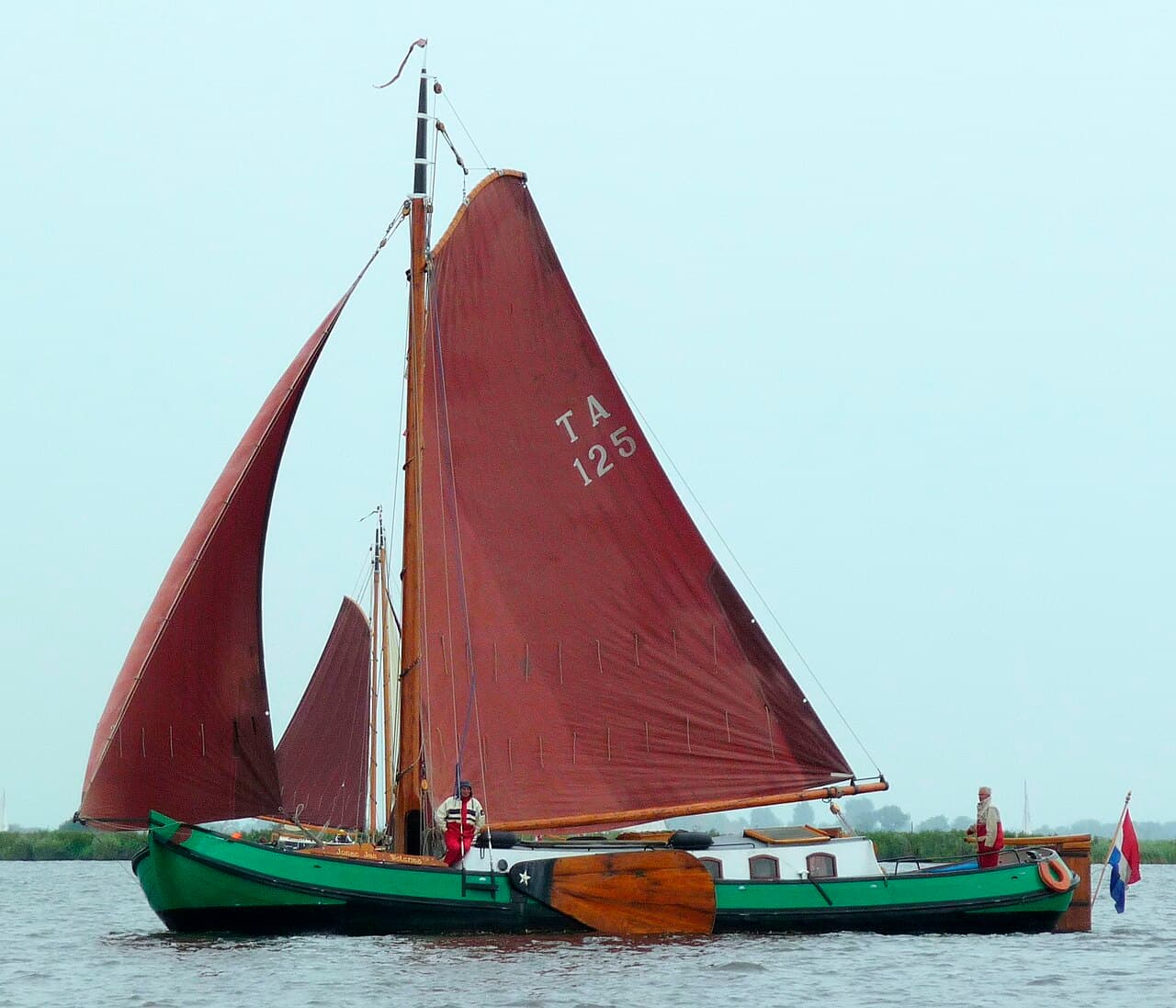
Jonge Jan (TA125) at the VSRP reunion in 2010: an individual tjalk illustrating the broader ship family.
Merlijn 'valhallasw' van Deen / Wikimedia Commons · CC BY-SA 3.0 · Image shown uncropped.
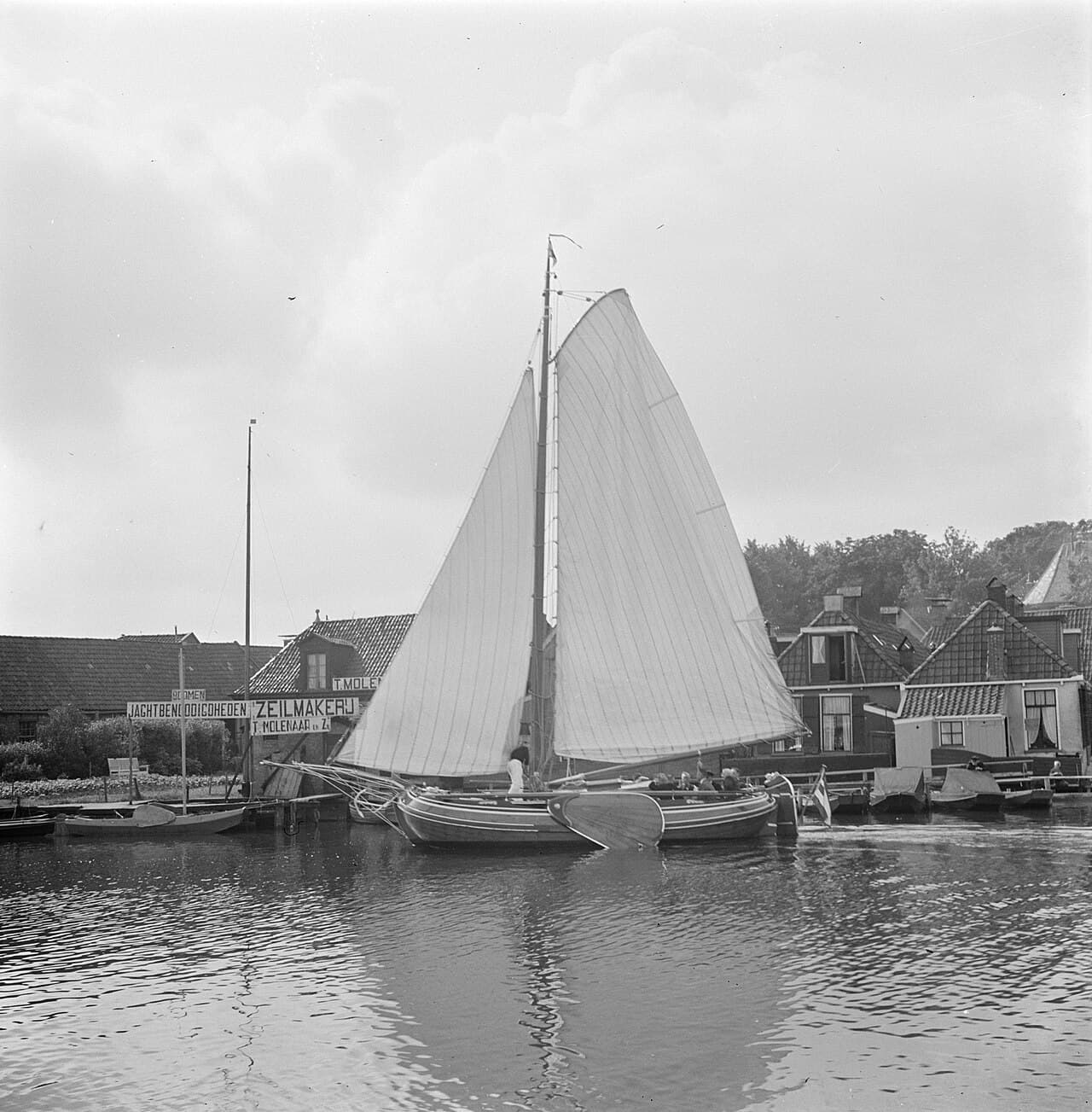
A tjalk passing a sailmaker’s premises at Grouw; archival photograph by Willem van de Poll, Nationaal Archief, reference 191-0671.
Willem van de Poll / Wikimedia Commons · CC0 · Image shown uncropped.
Gedocumenteerde geschiedenis
A cargo landscape in the shape of a boat
The SSRP identifies the tjalk as a widely used sailing cargo vessel in Holland and Friesland. Its surviving presence extends beyond sailing: former working craft can also be encountered as motor vessels, yachts and houseboats. These later uses belong to the biography of individual hulls. They do not make every boat with a domestic conversion an unchanged example of a historic sailing arrangement.
Bronnen: [1]
A family rather than a standard model
The registry groups the tjalk with the skûtsje, paviljoentjalk, Zuid-Hollandse tjalk and boeierschuit. Its wider classification places these boats among the flat-bottomed craft developed for regional work. This is a useful warning against giving the whole family one length, one year or one designer. A type dossier introduces the relationships; a named-vessel dossier must establish the particular boat’s provenance separately.
The ship as workplace and home
The historical typology preserved in the SSRP archive describes tjalk-like vessels as a major presence on Dutch inland waters around the turn of the twentieth century. Many were also homes for the skipper’s family. Freight, domestic space and movement belonged to the same compact world. Reading that working history adds a human scale to the surviving hulls, beyond their present appearance as leisure or residential vessels.
Bronnen: [3]
Onze lezing · Redactionele duiding
Het schip en zijn omgeving lezen
The tjalk changes how one looks at an inland town. A quay becomes a place of exchange rather than simply a waterside view; the relationship between storage, streets and water becomes easier to imagine. Our interest is in that connection. When looking at a converted vessel, ask which parts still reveal the former cargo arrangement and which answer a later use. Such questions allow change to be visible without turning every alteration into either an improvement or a loss. The photograph of Jonge Jan illustrates one boat, not a specification for the family.
Bezoek en ontdek · Redactionele aanbeveling
Volg het verhaal
Use the registry to identify named vessels and follow their individual histories. Access, public sailing and mooring locations must be checked with the relevant owner or museum; inclusion here does not imply public boarding.
SSRP — Tjalk family ↗