Individual historic ship · Rotterdam, South Holland
ss Rotterdam
A Dutch ocean liner as a world of interiors, engineering and passage
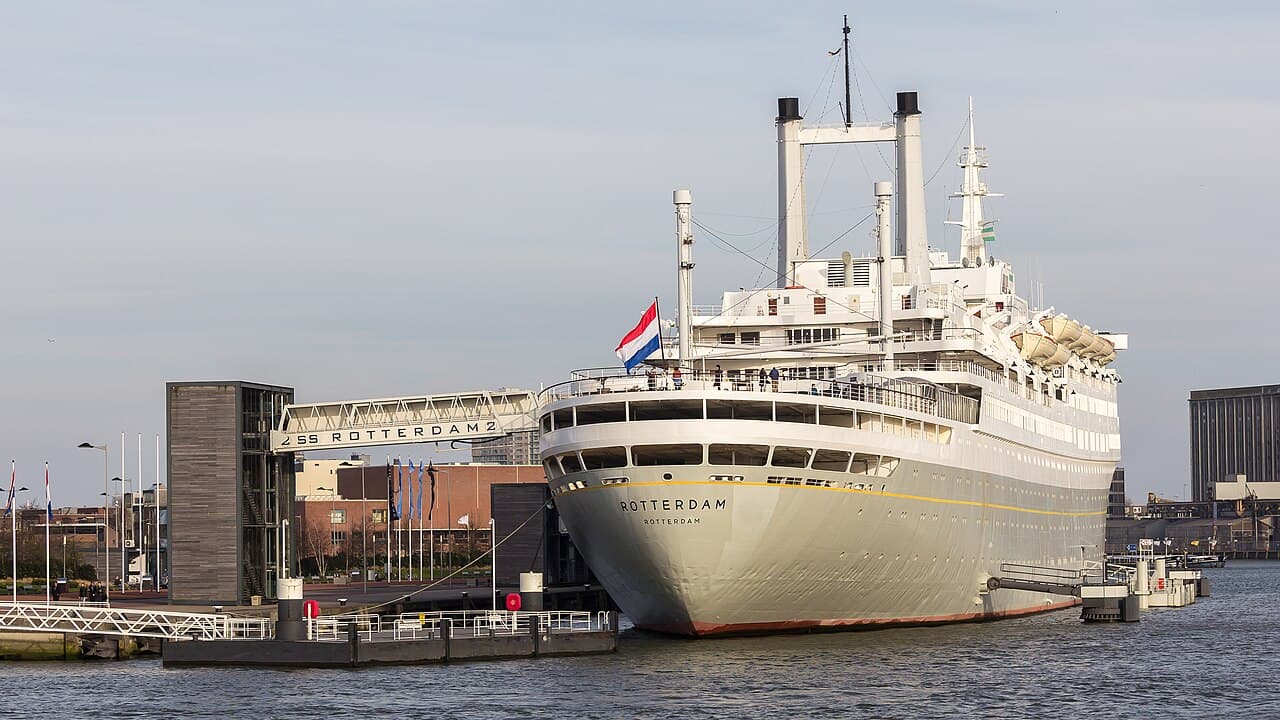
ss Rotterdam at Rotterdam, photographed by Raimond Spekking. The image depicts the individual ship discussed in this dossier.
Raimond Spekking / Wikimedia Commons · CC BY-SA 4.0 · Image shown uncropped.
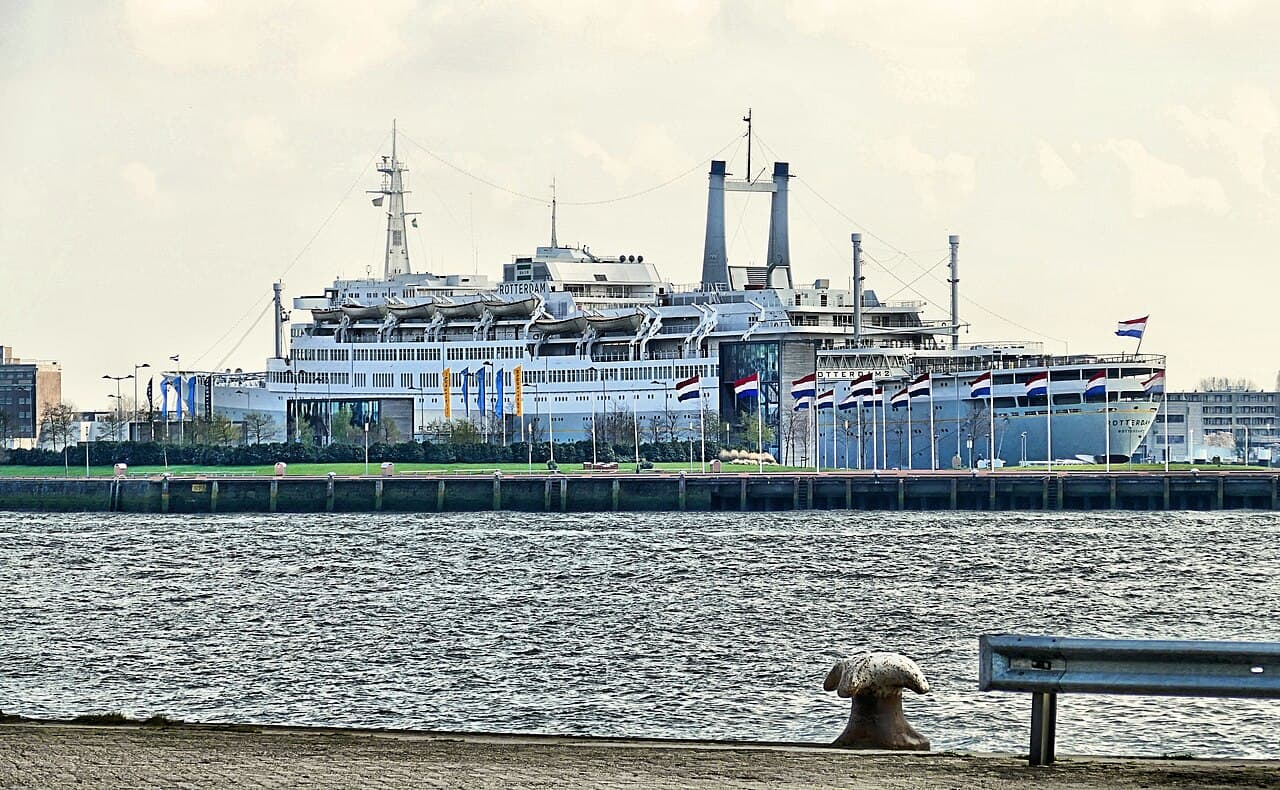
A second view of ss Rotterdam, photographed by Jan Geerling; an independent image of the same vessel.
Jan Geerling / Wikimedia Commons · CC BY-SA 4.0 · Image shown uncropped.
Gedocumenteerde geschiedenis
Built for a changing Atlantic
Launched at RDM on 13 September 1958, Rotterdam entered service for Holland-Amerika Lijn in September 1959. The ship’s preservation foundation records the maiden voyage on 3 September and identifies the vessel as a late example of the ocean liner. This dossier concerns that particular Rotterdam, not earlier ships bearing the name and not a general class of Dutch passenger vessels.
Bronnen: [1]
Architecture aboard
The operator’s history describes a profile shaped by the position of the machinery and paired exhaust uptakes, with a prominent deckhouse where a conventional funnel might have been expected. It also places considerable emphasis on interiors: designers and artists were engaged to create spaces that combined practical use with a contemporary visual language. The same account gives the ship’s overall length as 228 metres and width as 28 metres.
Bronnen: [2]
Preservation beyond the silhouette
The Vrienden van stoomschip Rotterdam draw attention to the surviving steam-turbine installation, interiors and artworks. Their importance is that maritime heritage can be encountered within the ship as well as from the quay. The operator’s published history follows the vessel from Atlantic crossings through cruising and its later life ashore in Rotterdam. That succession of uses belongs to the same ship, even as its relationship with passengers has changed.
Onze lezing · Redactionele duiding
Het schip en zijn omgeving lezen
A visit is most rewarding when approached as a sequence of spaces. Set the public rooms against the working systems that made them possible, and the vessel against the city that built it. This offers a richer reading than a portrait of glamorous travel alone. The ship can connect design history with labour and infrastructure without pretending that all passengers experienced a crossing in the same way. It also offers Bateau a useful counterpoint to small regional craft: different scales of vessel, each organising life around water.
Bezoek en ontdek · Redactionele aanbeveling
Volg het verhaal
Use the operator’s current programme to check tours, access and reservations. Choose an engineering or interiors route according to your interests, and verify which spaces it includes. This is an independent editorial dossier; no partnership or certification by Le Cercle is implied.
ss Rotterdam — Official visitor information ↗