Individual historic ship · Hamburg
Peking
A Hamburg sailing ship and the global trade carried in her hold
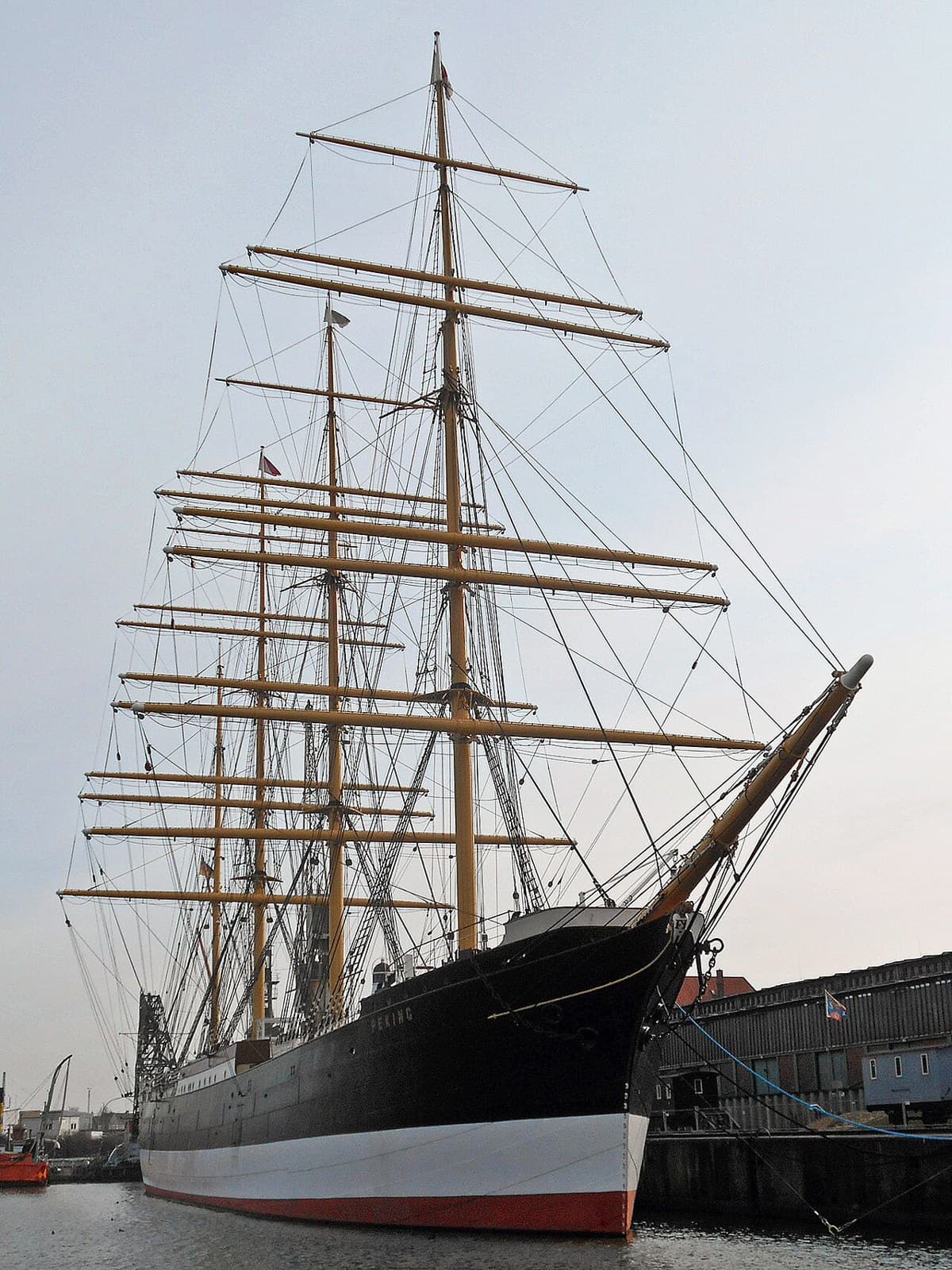
Peking at Hamburg in 2022: the preserved four-masted barque.
Wolfgang Fricke / Wikimedia Commons · CC BY 3.0 · Image shown uncropped.
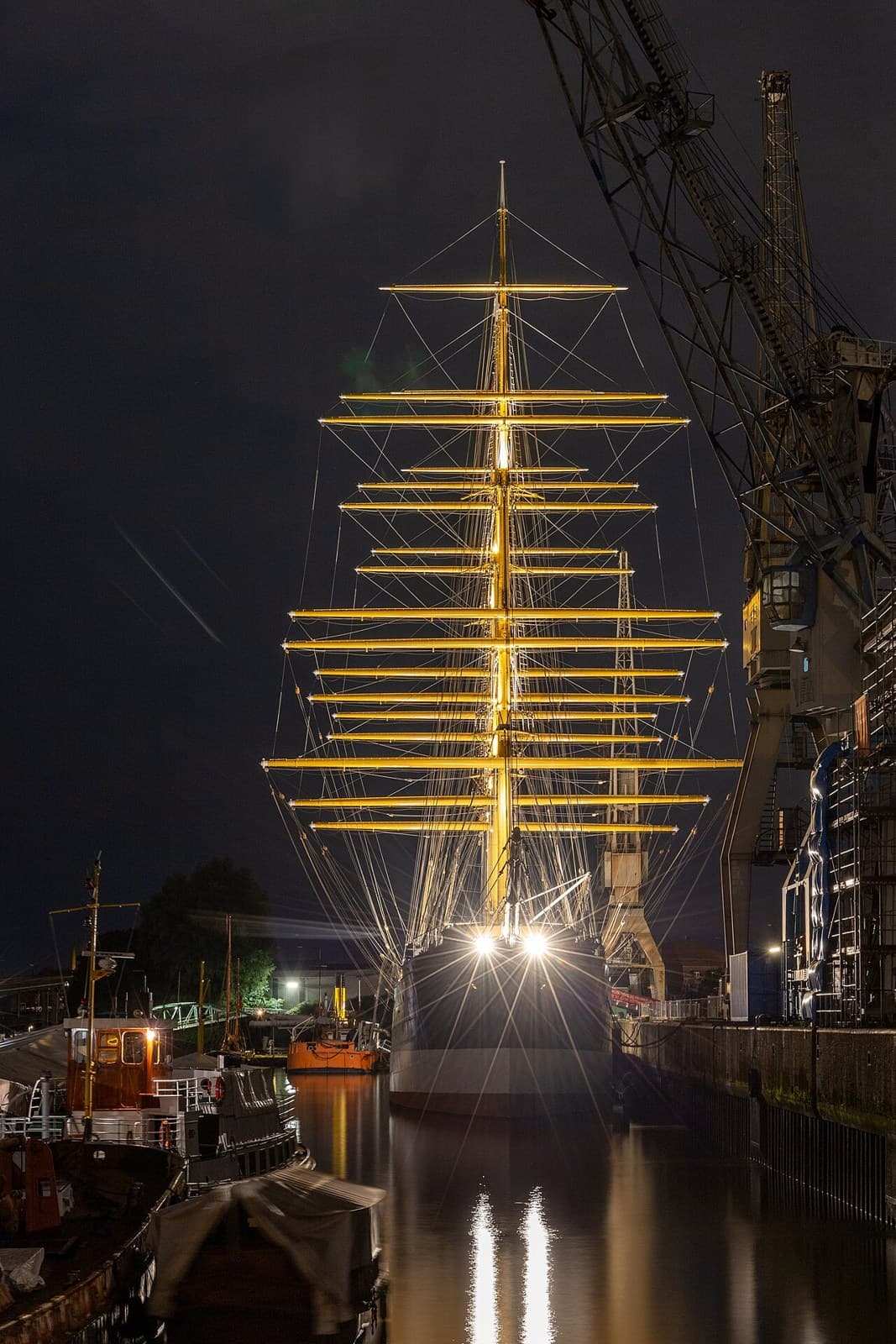
Peking illuminated at Hamburg in 2025: a dated night-time photograph.
Matthias Süßen / Wikimedia Commons · CC BY-SA 4.0 · Image shown uncropped.
Documented history
A hull for a particular trade
Hamburg's museum foundation records Peking as built by Blohm & Voss in 1911 for F. Laeisz. The vessel carried general and bulk cargoes, including saltpetre, between Hamburg and Chile until 1932. The ship is therefore evidence of a global trading relationship, not simply a local achievement in shipbuilding. Builder, owner, ports and cargo are all needed to understand why a large sailing barque still had a commercial role.
Sources: [1]
The commodity behind the voyage
The museum's interpretation relates Chilean saltpetre to fertilisers, explosives and dyes, and places the trade in the context of deposits in the Atacama Desert. This gives the hold a history beyond its dimensions. A cargo ship links extraction and loading with distant industrial and agricultural uses. Peking's story opens Hamburg towards those connections rather than containing the vessel within a purely European account of elegant sail.
Sources: [1]
A return and a new museum life
The foundation's account of Peking's return records her arrival back in Hamburg in 2020, following the recovery and restoration project. Its current exhibition information distinguishes the present setting from the planned future museum site. The sequence matters: restoration, arrival and permanent interpretation are separate stages. A visitor should use current museum guidance rather than assume that an announced future location has already opened.
Our reading · Editorial interpretation
Reading the ship and its setting
Begin with an imagined cargo rather than the skyline. What was carried, where was it obtained and what work awaited it after unloading? Those questions give the vessel an economic and environmental setting. Then consider the ship's return as another movement requiring planning, resources and care. Peking can be admired for her form while also being read as a material connection between distant places, industrial demand and the choices through which a city decides to preserve its port history.
Visit & explore · Editorial recommendation
Follow the story
Check SHMH's current Peking visitor information for the actual location, tours and access arrangements. Museum development plans should be read with their publication dates. This independent dossier does not imply a partnership with the museum or access beyond its announced public programme.
SHMH — Discover Peking ↗