Individual historic ship · Bristol
SS Great Britain
An iron steamship whose survival connects Bristol with the South Atlantic
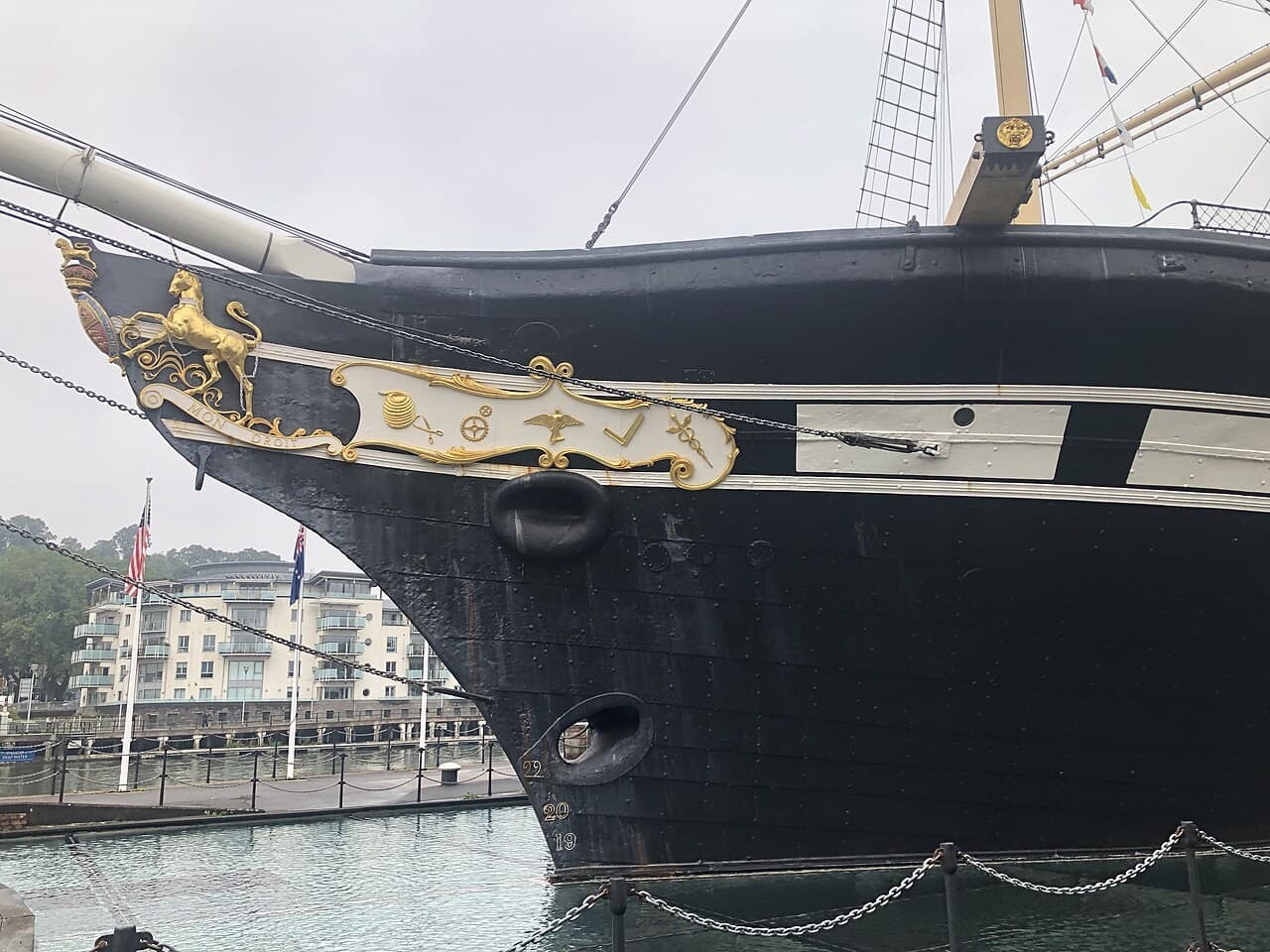
The bow of SS Great Britain in the Great Western Dockyard at Bristol: the ship within its original construction setting.
Nortix08 / Wikimedia Commons · CC BY-SA 4.0 · Image shown uncropped.

The propeller of SS Great Britain in the Bristol dry dock: machinery within the museum interpretation.
Nortix08 / Wikimedia Commons · CC BY-SA 4.0 · Image shown uncropped.
Documented history
An ambitious Atlantic ship
National Historic Ships records Great Britain's launch at Bristol on 19 July 1843, with Prince Albert present. Designed by Isambard Kingdom Brunel, the vessel combined an iron hull with steam-driven screw propulsion. Those choices make a useful starting point for understanding her importance. They also belong to a passenger ship with demanding commercial ambitions, rather than to an isolated experiment detached from the practical business of carrying people across an ocean.
Sources: [1]
Changes in work and geography
The register follows the ship from Atlantic voyages to Australian service after her sale to Gibbs, Bright and Company in 1850. Military transport became another chapter. Later conversion to sail and service carrying cargo altered the original arrangement again. Damage near Cape Horn in 1886 led to a long period in the Falkland Islands. The surviving vessel therefore contains a wider history than the machinery with which she first left Bristol.
Sources: [1]
Returning a survivor
The museum's account describes the remarkable recovery and return to Bristol in 1970. The ship came back to the dock where she had been built, creating an unusually direct relationship between museum object and industrial place. Conservation is central to that relationship. A visitor encounters a surviving iron hull together with researched interpretation and reconstructed spaces; distinguishing these layers is part of understanding the achievement of preservation.
Sources: [2]
Our reading · Editorial interpretation
Reading the ship and its setting
Read the dock and the hull together. The enclosed building space makes the scale of the undertaking easier to grasp than a distant view of a ship at sea. Then follow the changes in use: passenger accommodation, machinery, cargo and preservation each ask different things of the same structure. This is an account of adaptation as much as invention. The long South Atlantic chapter also prevents Bristol from becoming the only geographical frame through which the ship is understood.
Visit & explore · Editorial recommendation
Follow the story
Consult the museum's current Bristol visitor information for opening, tickets and access arrangements. Check the particular spaces included in a visit, especially where steps or confined passages are involved. The preserved ship is an interpretation setting; no passenger voyage is implied by this dossier.
National Historic Ships — SS Great Britain ↗