Regional ship type · Scotland’s east coast
Fifie
The east-coast herring fishery seen through a sailing drifter
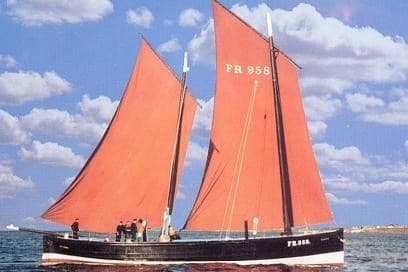
Reaper (FR958) under sail: a named example illustrating the Scottish fifie tradition.
Cactus.man / Wikimedia Commons · CC BY-SA 3.0 · Image shown uncropped.
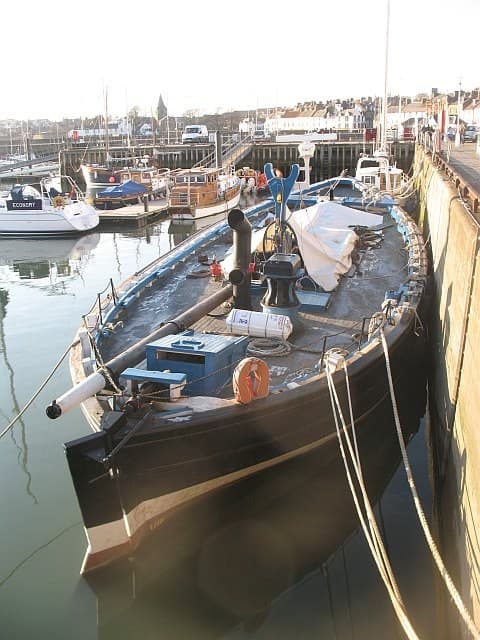
Reaper in harbour: a second view of the same preserved fishing vessel.
Richard Webb / Wikimedia Commons · CC BY-SA 2.0 · Image shown uncropped.
Gedocumenteerde geschiedenis
A familiar form on Scotland’s east coast
The Scottish Fisheries Museum identifies the Fifie as a leading fishing-boat design on the east coast during much of the nineteenth and early twentieth centuries. Its account of Reaper offers a named example: built by J & G Forbes at Sandhaven in 1902, she began as a two-masted sailing lugger. The type connects a hull and rig with a particular fishery, rather than representing Scottish boats in general.
Bronnen: [1]
One boat, more than one registration
Reaper was initially registered at Fraserburgh as FR958 and later at Lerwick as LK707 after moving to Shetland ownership. The museum records work in drift-net and great-line fishing, alongside changes across the vessel's long career. These details illustrate how an individual boat's identity can be traced through records. They are not a chronology for every Fifie, nor evidence that all preserved boats retain their first arrangement.
Bronnen: [1]
A flagship with a conservation history
The museum presents Reaper as its flagship and documents the major refit undertaken in 2017–2019. The vessel is part of a larger collection which helps explain fishing equipment, work and coastal communities. A preserved working boat can show scale and space in a way a model cannot, but its condition also results from repeated maintenance. The museum's accounts allow those later interventions to remain part of the story.
Bronnen: [2]
Onze lezing · Redactionele duiding
Het schip en zijn omgeving lezen
Start with the relationship between the rig, the working deck and the catch. A museum boat may look composed at her berth, yet the historical subject is labour in a demanding and seasonal fishery. Compare equipment with the space in which people had to use it. Reading the vessel this way also prevents the sail plan from becoming a decorative shorthand for Scottish heritage. The details of a particular refit can be as revealing as a distant image of the boat under canvas.
Bezoek en ontdek · Redactionele aanbeveling
Volg het verhaal
Consult the Scottish Fisheries Museum at Anstruther for current exhibitions and Reaper information. Confirm where the boat is and whether boarding is possible. Outreach voyages and museum access vary; the photographed vessel should not be assumed to remain at one berth throughout the year.
Scottish Fisheries Museum — The story of Reaper ↗